Written and clinically reviewed by Tim Wood, BSc (Hons) Osteopathy, Registered Osteopath (GOsC) Published: 16 October 2026 · Last reviewed: 16 October 2026
Osteopathy shouldn’t hurt in the sense of causing sharp or severe pain, but it’s honest to say some techniques can cause mild, temporary soreness afterwards, similar to how you might feel after a deep massage or a first session back at the gym. If you’re already in pain, working on the affected area can occasionally feel tender in the moment, but a good osteopath adjusts pressure and technique continuously based on your feedback, and nothing should ever feel like it’s being forced.
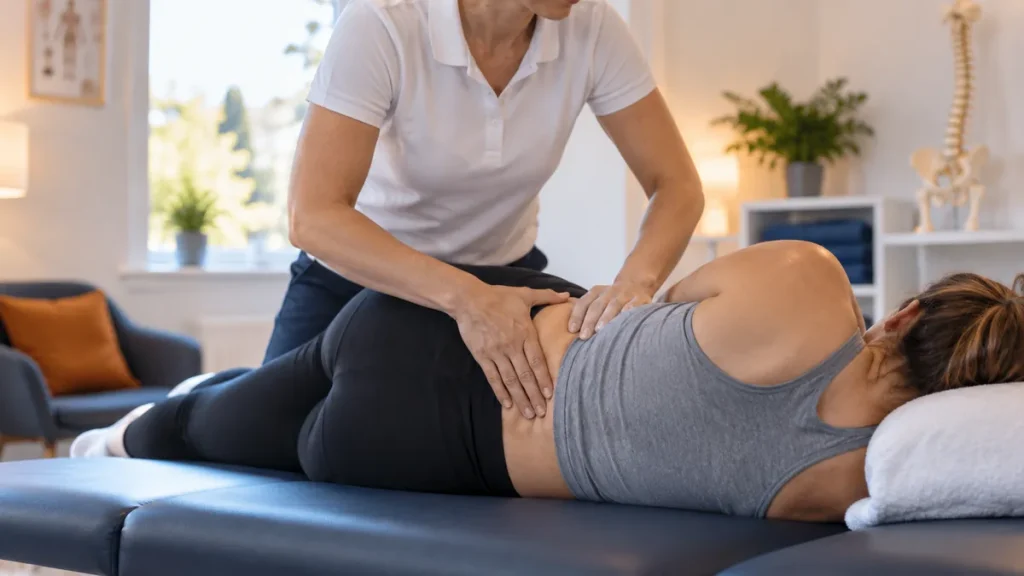
The most common reason people expect it to hurt is confusing osteopathy with the “cracking” techniques seen in videos online, which represent only a small part of what a typical session actually involves. Most of an osteopathic appointment is gentle, hands-on assessment and soft tissue work, stretching, rhythmic pressure, and mobilisation of joints within a comfortable range, not forceful manipulation.
If you’re nervous about your first appointment, the most useful thing you can do is simply tell your osteopath, at any point, if something feels too much, treatment is adjusted in real time based on what you say, not delivered as a fixed script regardless of your feedback. The rest of this article covers exactly what a first appointment looks like step by step, what the honest evidence says about soreness and safety, and the specific situations where you should see a GP rather than book an osteopathy appointment.
What actually happens, step by step
Understanding the structure of a session removes most of the uncertainty that makes people nervous.
1. Case history (10-15 minutes). Your osteopath asks about your current problem, when it started, what makes it better or worse, your general health, and any relevant medical history. Nothing physical happens during this part; it’s a conversation.
2. Physical assessment. You may be asked to move in certain ways (bending, reaching, walking) so your osteopath can see how your body is functioning. You may be asked to remove or adjust some clothing so the area can be examined properly, and shorts or a vest are always welcome if that’s more comfortable; you’re welcome to bring a friend or relative with you, and your osteopath will explain what they’re doing and ask your consent at each step.
3. Explanation. Before any treatment starts, your osteopath explains what they’ve found and what they’re planning to do, and why. You should always understand what’s about to happen before it happens.
4. Treatment. This is typically a combination of soft tissue massage-style techniques, joint mobilisation (moving a joint gently within its normal range), stretching, and, sometimes, a specific quick, controlled joint movement (the “click” technique, more accurately called high-velocity low-amplitude thrust), which is used far less often than people assume and only where it’s appropriate and you’re comfortable with it.
5. Aftercare advice. You’ll usually be given simple guidance on what to do (and avoid) for the next day or two, and any home exercises if relevant.
A first appointment typically runs 45 minutes to an hour; follow-up sessions are usually shorter, around 30 minutes.
Mechanism: why treatment can cause temporary soreness, and why that’s not the same as harm
When soft tissue that’s been tight or guarded for a while is worked on, whether by an osteopath’s hands, a sports massage, or your own stretching, the local tissue experiences a mild, controlled inflammatory response as part of normal repair and adaptation, similar to the process that makes muscles feel sore the day after unfamiliar exercise (delayed onset muscle soreness). This is a normal physiological response to mechanical load on tissue, not tissue damage, and it typically peaks within 24 to 48 hours and settles on its own.
With joint mobilisation and manipulation specifically, gentle movement of a joint within or slightly beyond its usual resting range can also mildly irritate the joint capsule and surrounding ligaments in a similar, temporary way, particularly if the joint has been stiff or restricted for some time. This explains the well-documented pattern in the research: mild, short-lived soreness after treatment is common and expected, while anything severe, or pain that’s getting worse rather than settling over a day or two, is not typical and is worth reporting back to your osteopath.
Guarded, protective muscle tension (the tightness your body creates around an irritated joint or injury as a kind of natural splint) is often what treatment is actually working to release, and releasing that tension can itself feel like a strange, sometimes achy sensation in the moment, which is different from pain and usually eases quickly once the technique is finished.
When to worry: red flags that mean same-day medical attention, not osteopathy
Osteopathy is a safe, regulated healthcare profession, but it isn’t right for every symptom, and a responsible osteopath will always redirect you if needed. See your GP the same day, call NHS 111, or go to A&E/999 if severe, for:
- Sudden, severe headache described as “the worst of your life”, or a headache with visual disturbance, confusion or fever.
- Chest pain, or pain spreading to your jaw or arm, alongside breathlessness.
- Numbness, weakness, or loss of bladder or bowel control, particularly around the saddle area (this can indicate cauda equina syndrome, a rare but serious emergency).
- Unexplained weight loss, night sweats, or a history of cancer alongside new back or joint pain.
- Pain following a significant trauma with suspected fracture.
If none of these apply, booking an osteopathy assessment is an appropriate and safe next step, and a thorough case history is specifically designed to catch anything that needs redirecting elsewhere before any treatment begins.
What the evidence actually says
The most honest evidence on this comes from a 2007 systematic review published in the Journal of the Royal Society of Medicine, looking at adverse effects of spinal manipulation generally (a technique used across osteopathy, physiotherapy and chiropractic). It found that mild to moderate adverse effects, most commonly local soreness, stiffness or fatigue, occurred in an estimated 30-61% of patients, while serious complications were rare. This is a useful, if slightly sobering, number: it confirms that some post-treatment soreness is genuinely common rather than something to feel alarmed about, while also being honest that it isn’t nothing.
The General Osteopathic Council (GOsC), which regulates every osteopath in the UK by law, monitors adverse events reported by patients and practitioners as part of its statutory role, and publishes guidance on this as part of ensuring standards across the profession. Being registered with the GOsC (which every osteopath at our clinics is) means a practitioner has met defined training and safety standards and is accountable to a professional regulator, in the same way a doctor is accountable to the GMC. Separately, the National Council for Osteopathic Research, an independent research body, has highlighted that better standardised reporting of adverse events across the profession is still an active area of improvement, which we think is worth being upfront about rather than glossing over.
The NHS’s own service directory confirms osteopathy is a regulated profession overseen by the GOsC. What this means in practice: mild, short-lived soreness after treatment is a genuinely common and normal part of the process for a meaningful proportion of patients, serious harm is rare, and choosing a GOsC-registered osteopath is the single most important safety factor within your control.
How your first visit works at Tim Wood Healthcare
Every new patient gets a full case history and a holistic, whole-body assessment, looking beyond just the painful area, because we regularly find that where something hurts and what’s actually causing it are in different places. First appointments run 45 minutes to an hour, giving proper time for assessment and explanation rather than rushing straight to treatment.
If you’re still unsure whether osteopathy is right for your specific situation, our free 15-minute phone consultation lets you talk through your symptoms with one of our team before you book anything, with genuinely no obligation, it exists specifically because we know first-appointment nerves are common and completely understandable.
Common questions
Will my osteopath crack my joints?
Not necessarily, and not without discussing it with you first. High-velocity thrust techniques (the “click”) are one tool among many, used selectively where appropriate, and always with your understanding and comfort beforehand. Plenty of effective treatment involves no clicking at all.
How sore will I feel after my first session?
Many people feel nothing unusual at all. Some notice mild soreness or tiredness in the treated area for a day or two, similar to how you’d feel after a firm massage or unfamiliar exercise, which typically settles on its own. Pain that’s severe or worsening rather than settling isn’t typical and should be reported to your osteopath.
Do I need to get undressed for treatment?
You may be asked to remove or adjust some clothing so the area can be properly examined and treated; shorts or a vest are always welcome if that’s more comfortable, and you’re welcome to bring a friend or relative with you. Your osteopath will explain what they’re doing and ask your consent at each step.
Is osteopathy safe for older adults or people with osteoporosis?
Yes, but it’s essential to mention any bone health concerns during your case history, as technique choice is adapted accordingly, using gentler, lower-force approaches rather than higher-velocity techniques where bone fragility is a factor.
How many sessions will I need?
This varies by individual and condition, and a responsible osteopath won’t promise a fixed number upfront. Many people notice some improvement within the first one to three sessions, with a plan reviewed and adjusted as you progress rather than committing you to a lengthy course from the outset.
What if I’m not sure osteopathy is right for me?
That’s exactly what our free 15-minute phone consultation is for. You can describe your symptoms and ask questions before booking a full appointment, with no obligation to proceed.
About the author
Tim Wood is a registered osteopath (GOsC) and the founder of Tim Wood Healthcare, qualified in 2007 with a BSc (Hons) in Osteopathy. He has spent over 15 years treating patients across Rainham and Maidstone, working within a team with 40+ years of combined practitioner experience, all registered with the General Osteopathic Council. Find out more about our osteopathic care.
Still have questions before booking?
If you’re ready to get to the bottom of your pain, our osteopaths at Tim Wood Healthcare are here to help. Book an appointment at our Rainham or Maidstone clinic, or take advantage of our free 15-minute phone consultation to have your questions answered before your first visit.